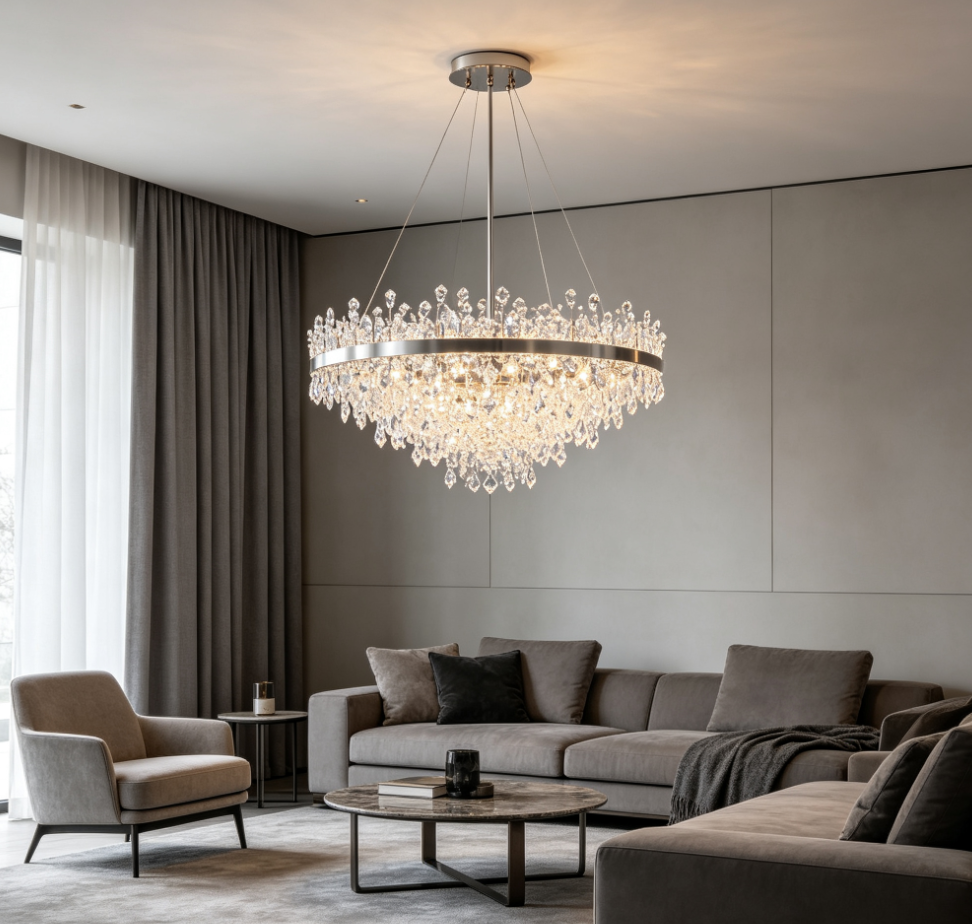
When a client points to a crystal chandelier in a reference image, find out what they are choosing. It could be the crystal itself. They might also be drawn to the outline, the scale or the way the fitting sits above the tables. That matters if someone later asks for an acrylic version.
The request might come from purchasing, hoping for a different price, or from the venue team, concerned about handling the finished fitting. An acrylic proposal needs to answer that particular concern. Keeping the outline from the photograph does not establish what the complete chandelier will look like, weigh or require after installation.
I’d be careful about treating acrylic as the consolation prize. If crystal is central to the client’s brief, say so early. If the client mainly wants the shape and scale of the reference, there may be more room to discuss materials. Otherwise, a supplier can spend time developing an alternative that nobody really wanted.
The Wedding Is Only Part of the Conversation
For a venue that wants a formal, sparkling centrepiece, a crystal chandelier may be worth the attention it draws. The chandelier might be part of what people like about the room. There is no particular virtue in making it less prominent just because a quieter design would be easier to coordinate.
The complication is the rest of the booking calendar. A hall used for presentations needs to be considered from the audience seats as well as from the entrance. Look towards the stage. Decide whether the chandelier should remain a noticeable feature or recede while people are watching a speaker.
The operator may be happy for it to dominate every event. Another operator may want more freedom to change the room’s character. Neither preference can be read from a picture of the empty hall.
An acrylic chandelier deserves to be considered as a design in its own right. Look at the proposed shape, the arrangement of its parts and its illuminated appearance. It does not have to mimic the crystal option to deserve consideration. Equally, changing the material is no reason to accept an awkward proportion or an effect the client dislikes.
For a Lanting Jixu enquiry, send the supplier the room views and explain which bookings the hall needs to accommodate. Include what the client likes about the reference. Is it the outline, the visible decorative pieces or the way it becomes the room’s focal point? Otherwise, the supplier has to guess which feature should survive a change of material.
What the Samples Can Actually Show
A small sample is useful for looking at a surface or an edge. An illuminated section can help the designer judge part of the proposed effect. It cannot demonstrate the whole chandelier in the hall.
Keep track of what the team has actually seen. If a full lighting mockup is practical, use the proposed light sources and controls. If it isn’t, leave the room-level effect as an open question. Accepting a material sample should not quietly become approval of everything else.
Look at the fitting unlit, too. The hall will not always be shown at its preferred evening setting. The decorative structure still has to sit comfortably with the ceiling, walls and furniture when its lighting effect is absent.
The people responsible for receiving, installing and maintaining it need a place in the review before the design is settled.
Start with the complete weight. It is tempting to hear “acrylic” and relax about the installation, but the frame, dimensions and quantity of decorative parts still belong in that calculation. Get the manufacturer’s information for the final configuration and leave the assessment of support and installation to the qualified project team.
The route into the room can be a separate problem. A high ceiling doesn’t tell you whether the delivery can pass through the service entrance. Find out how the chandelier will arrive, where assembly is expected to happen and how the parts will be identified. The receiving team and installer need to be involved, rather than finding the arrangement already decided.
There is a similar gap between liking the decorative pieces and agreeing to look after them. Ask for cleaning guidance for the actual assembly, including its finishes and any surface treatments. A method suitable for one part should not simply be extended to every other material.
The venue manager can then discuss access and care with the team doing the work. A detailed fitting may be worthwhile. The decision becomes harder to defend if nobody has considered how to reach it between bookings.
For either crystal or acrylic chandeliers, replacement pieces deserve a specific answer. Can individual elements be supplied, and what reference will the supplier need? Confirm availability rather than assuming it. If spares are included, have them identified and give them a labelled storage location. Someone taking over the venue later should be able to connect those pieces to the right fitting.
If the design changes during approval, pass the changes on. An extra tier or a larger diameter is a new detail for the installation and receiving teams, even when the material remains unchanged. They need the revised dimensions, weight and assembly information while there is still time to plan, rather than discovering the difference when the cartons arrive.